
Emergency phones exist for one moment: when someone needs help and has no other way to call. Area-of-refuge phones, stairwell phones, parking-garage call boxes, blue-light campus phones, and pool and amenity emergency phones almost all run on analog POTS lines. POTS lines, the analog phone lines buildings have run on for decades, are being retired. AT&T, Verizon, Lumen, and Frontier have all filed discontinuance notices with the FCC, and in March 2025 the FCC cut the required customer notice period from 180 days to 90. A carrier can now give your building three months of warning before the copper goes dark.
An emergency phone on a dead line is a liability the day someone presses the button and nothing happens. We replace the lines behind every type of emergency phone with dual-pathway POTS-in-a-Box hardware, so the call still goes through during the outage that made someone need it.
The life-safety solution we install carries the approvals inspectors and insurers look for






Every Emergency Phone Type, One Solution
- Area-of-refuge and stairwell phones. Required by code in many buildings for accessible evacuation.
- Parking-garage and lot call boxes. Often the only way to reach help in a garage with no cell signal.
- Campus blue-light phones. Schools, universities, and corporate campuses.
- Pool, gym, and amenity emergency phones. Required at most commercial pools.
- Elevator emergency phones. Covered in depth on our elevator phone replacement page.
Why Plain Internet Is Not Enough
An emergency phone gets used during exactly the conditions that knock out a single connection: a power cut, a storm, a network failure. A line tapped off the building router goes down with the router. The replacement has to carry its own backup power and a second communication path.
Dual-Pathway, Not Just Cellular
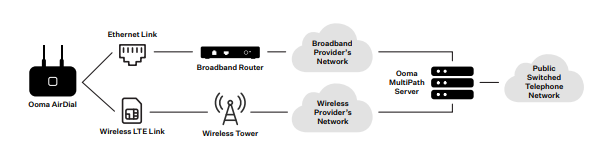
Every device we install runs dual-pathway. The line travels over cellular and over your building internet at the same time, and it fails over automatically the instant either path drops. Cellular-only replacements lose the line in a dead zone or a tower outage. Internet-only setups lose it whenever the building connection blips. Two independent paths is what keeps the line up when it is needed most.
It Costs Less Than the Copper You Have Now
Carriers now charge $80 to $280 per copper line every month, and the price climbs every year as they push the last customers off the network. Our POTS replacement starts under $30 per line per month. For most buildings the replacement costs less than the copper line it retires, and it is a more reliable line.
Install Process
Most emergency phone lines are a single-visit install:
- Site visit, about 30 minutes. We identify every line, check signal on both pathways, and confirm the power source.
- Number port. We port your existing numbers from the current carrier. It takes about two weeks and runs in parallel with the install.
- Install the POTS-in-a-Box device. It plugs in where the copper line was. The equipment behind it does not change.
- Test every line. We confirm a real dial tone and that the connected equipment recognizes the line.
- Decommission the carrier line. We coordinate the cancellation so you never double-pay.
Get a Free Emergency Phone Line Audit
Tell us how many emergency phones you have and where they are. We map every line, flag the ones at risk, and send a fixed-price migration plan.