The Storm Knocks Out Your Internet. Then Nobody Hears the Alarm.
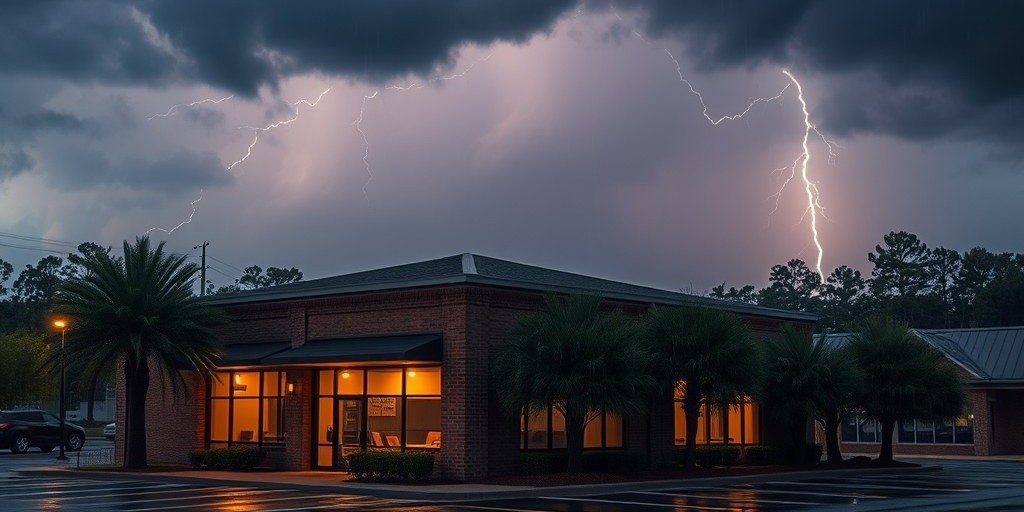
Every summer we get the same calls. A storm rolled through overnight, the internet is down, the phones are quiet, and nobody can tell if the building is okay until someone drives over to look.
Most of that is avoidable. And every fix is cheaper before the storm than after it.
Here is what actually happens when the weather hits, in the order it happens, and what it takes to keep a building running through it.
The internet goes first
A lightning strike two miles away can knock out the carrier equipment your whole street feeds from. You did not have to take a direct hit. When that equipment goes down, everyone on that segment goes down with it, and the outage usually outlasts the storm by a day or more while the carrier works through a stack of tickets.
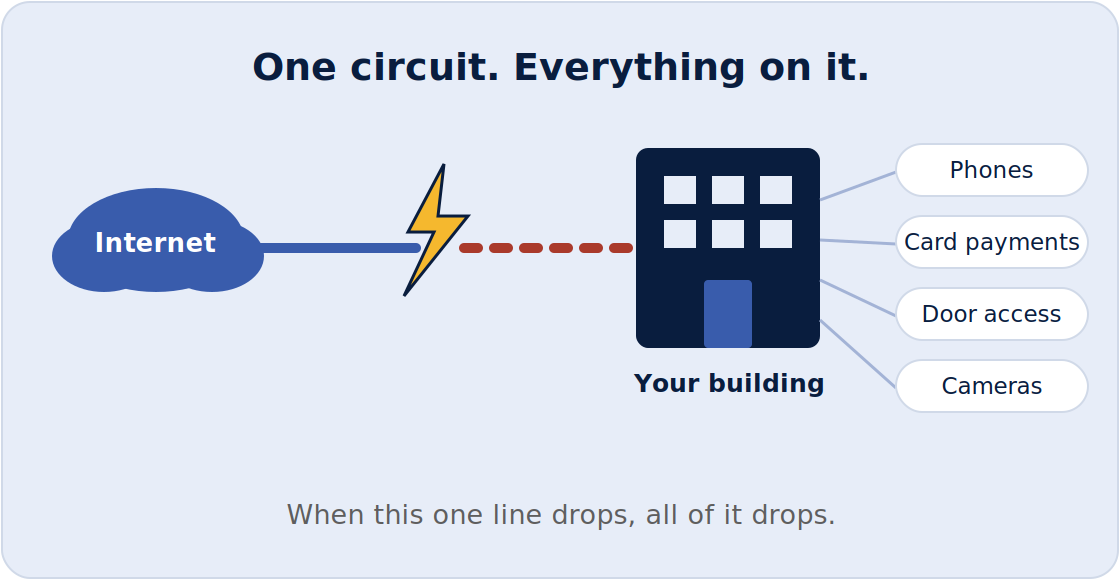
For most businesses, the internet is not one system that goes dark. It is the thing everything else is quietly riding on.
The phones follow it down
Most business phones ride the internet now. When the circuit drops, the phones drop with it. Callers get ring-no-answer, and a caller who gets ring-no-answer does not leave a voicemail. They move on to the next company on the list.
That is the part that costs real money and nobody sees on a report. You do not get a bill for the calls you never received.
Then there is the copper nobody sees
Under a lot of older buildings there is still analog copper doing quiet, important work: elevator phones, fire panel lines, and some alarm panels. The carriers are not maintaining that copper the way they used to. They are actively trying to retire it.
After a storm, a waterlogged line can die without a sound. Nothing beeps. Nobody gets an alert. You find out the hard way, when someone is stuck in an elevator pressing a call button that does not connect, or when you learn your fire panel has not been able to report in for a week.
This is the one most buildings never think about until it is a problem. It is worth thinking about first.
The fix is not exotic
You do not solve this with a generator and a prayer. You solve it with a second way out.
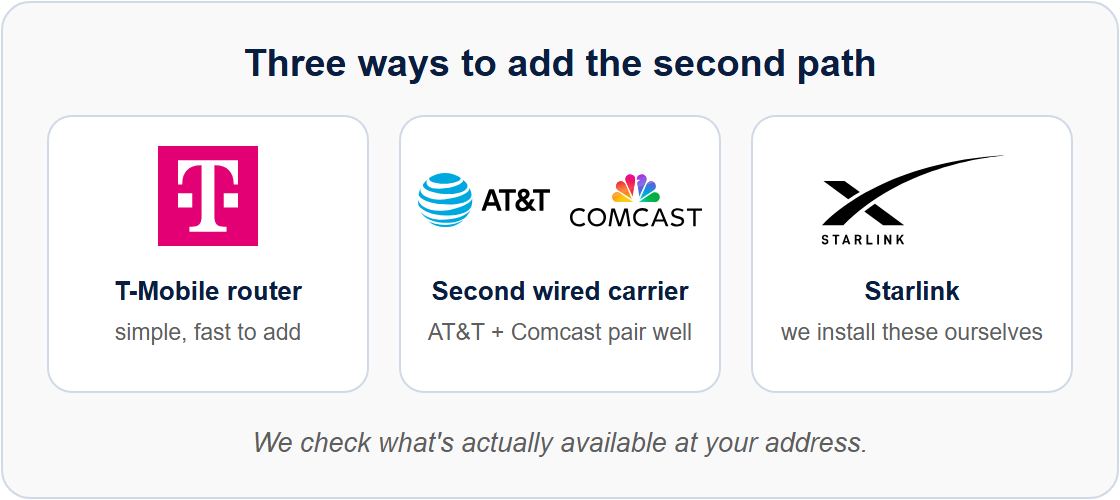
A cellular backup router sits behind your main circuit. When the main line drops, our RabbitRun SD-WAN sees it and switches traffic over to the backup automatically. Nobody in the office reboots anything or flips a switch. In most cases nobody even notices. The phones keep ringing, the card machines keep running, the cameras keep recording.
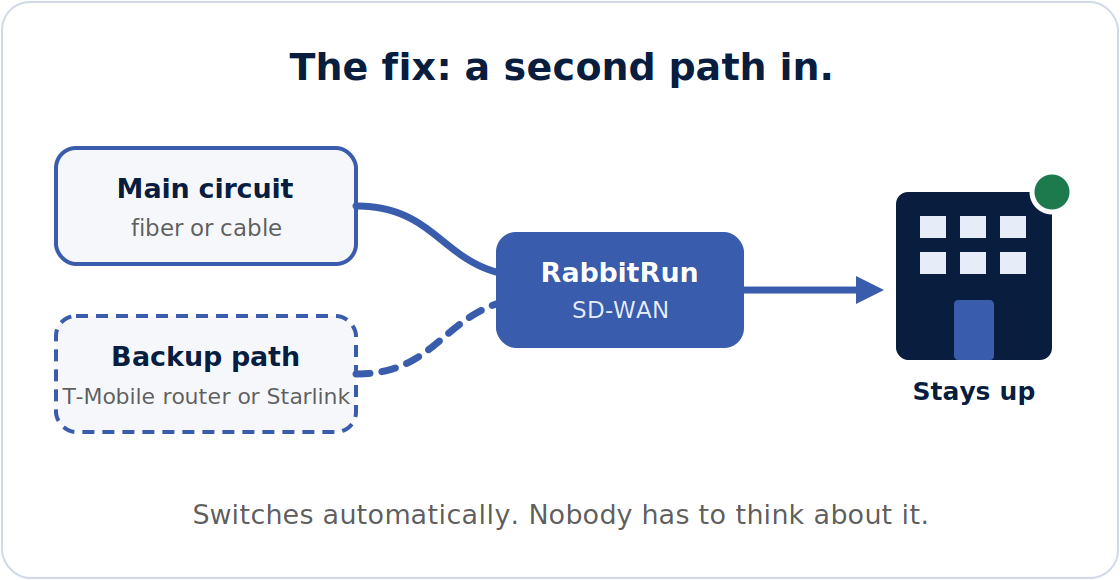
For a business that cannot afford to go dark at all, we go further. We can pair two wired carriers that do not share the same path into the building, or add Starlink as a fully independent route. We design it around what actually has to stay up for you, and we install all of it ourselves, so there is one crew and one number when something breaks.
A ten-minute check you can do this week
You do not need us to start. Three things, about ten minutes, and you will know where you stand.
- Walk the building and write down everything that depends on the internet: phones, card readers, door access, cameras. That list is your real exposure, and most owners are surprised by how long it is. Send that list to us at solutions@justinhallconsulting.com and we will tell you where the gaps are, no charge.
- Pick up the elevator phone and confirm it actually reaches the monitoring center. Not that it powers on. That it connects to a person. Two minutes.
- Call your alarm company and ask how your panel reports: internet, phone line, or cellular. One call settles it. If the answer is “phone line,” that is a line the carrier is trying to retire.
If any of those made you pause, that is the one to fix first.
A few things people do not know we handle
Storm readiness is connectivity, alarms, and the old phone lines. It is also a few things owners are surprised we do:
- Business cell phones. Still getting a phone bill with lines nobody can explain? We read the bill, kill the dead lines, and put the company cells on one plan we manage.
- Security cameras. Check the building from your phone after a storm instead of driving over at midnight to see if the lights are on.
- Smart building sensors. A moisture sensor in the right spot catches a Saturday-night leak before it becomes a Monday-morning flooring bill.
It is all the same idea: one contractor for the wiring, the phones, the cameras, the alarm, and the internet, so when something breaks you make one call instead of twenty.
The honest bottom line
If a storm took your internet out tonight, would your phones still ring and your alarm still report? If you are not sure, that uncertainty is the answer, and it is a lot cheaper to close the gap before the next storm than after it.
We are in metro Atlanta and work across the Southeast. If you want a set of eyes on your setup before summer really gets going, email us at solutions@justinhallconsulting.com and we will tell you where you stand. No charge to look.